An analytical approach to memorising music - Solfeggietto
Today, we will look at CPE Bach’s ‘Solfeggietto’ and how I would approach memorising this piece.
1) Identify the tonality
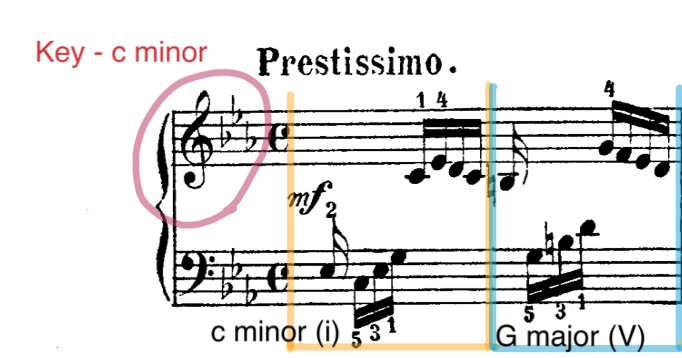
How do we work out what key the music is in? The key signature has 3 flats (circled in pink) which indicates that we are either in C minor or E flat major. If we look at the notes used for the opening motif, we see it’s a broken chord (E flat, C, G) - notes of C minor (i). The piece also ends on a descending C minor arpeggio which is a strong indication that we are in the key of C minor.
Why is it important to know what key the music is in? It’s important because 1) we know that the piece will mostly consist of the notes in the C minor scale 2) it helps us better understand the harmonic progressions.
2) Understand the structure
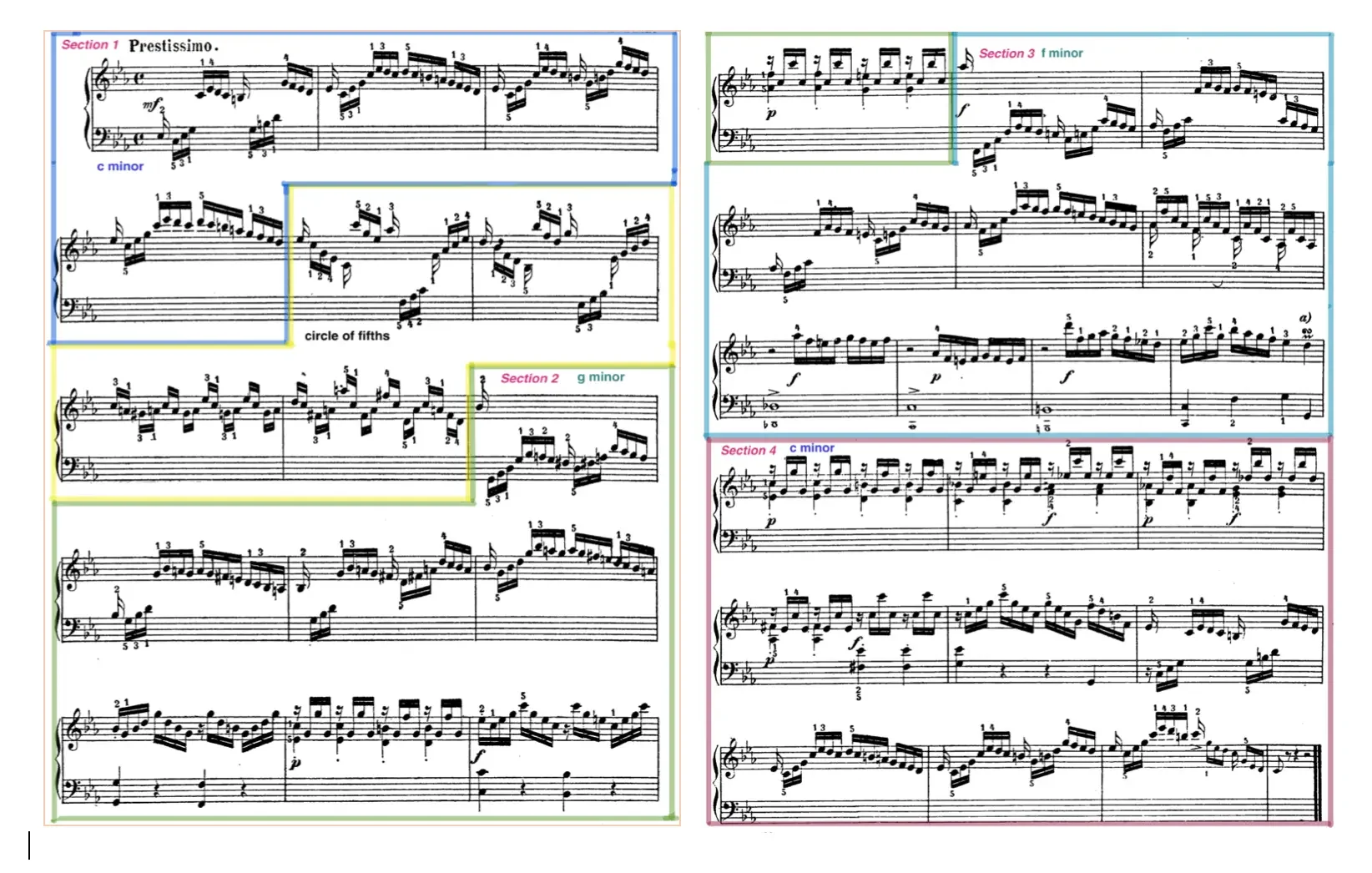
The piece consists of 4 main sections (as highlighted above). Section 1 is in C minor, Section 2 is in G minor, Section 3 is in F minor and Section 4 returns to the home key of C minor. Understanding how the music is constructed allows you to know where these ‘landmark points’ are. In this case, the main sections indicate a shift in tonality. This is particularly helpful when you get lost when performing and need to find your place.
3) Harmonic progressions
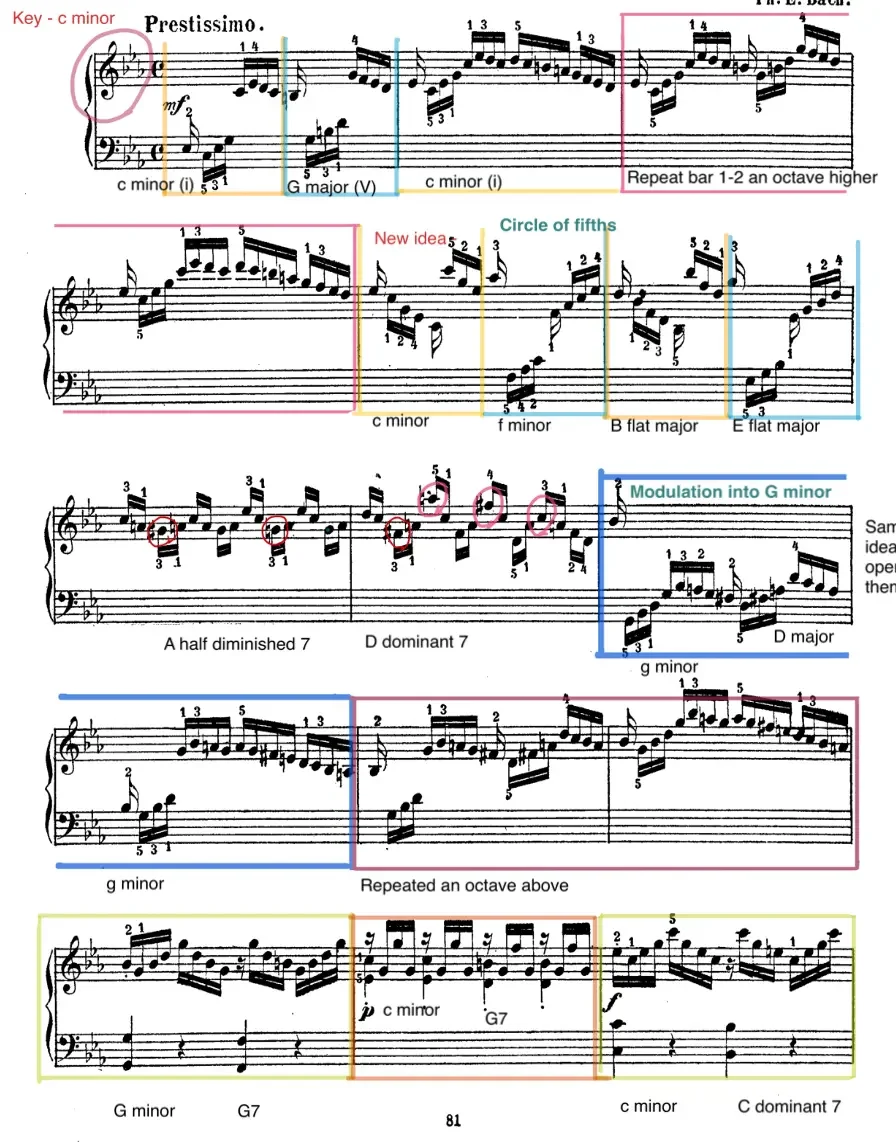
Here, I have annotated whenever there is a change in harmony. When memorising music it’s helpful to know what chord you’re on at any given moment.
4) Identify patterns
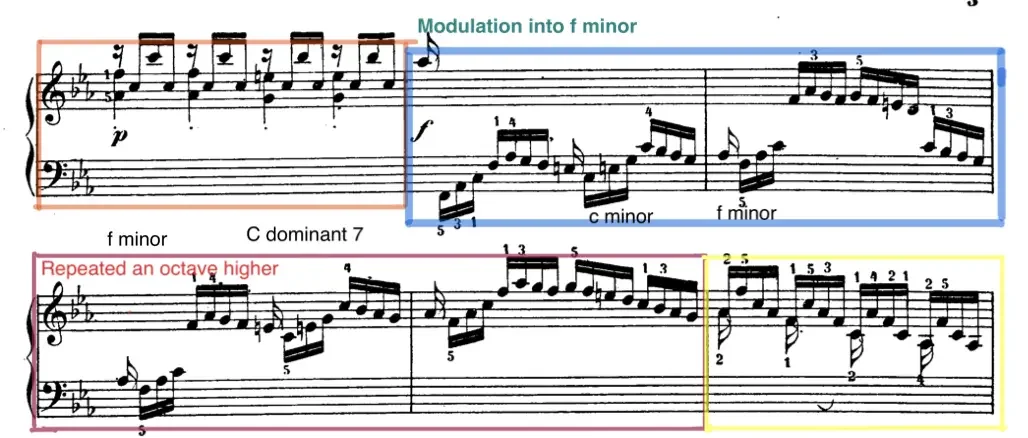
Knowing where melodic materials repeat speeds up the memorisation process. For instance, the passage coloured in blue is repeated an octave above (in pink). This pattern of the main motif being repeated up an octave happens several times in this piece.
Effective memorisation involves approaching the music from different angles. This includes paying attention to melodic patterns, harmony, structure and tonality when you are learning and memorising the music. This type of memorisation (theory based) is particularly important when muscle memory fails as you would have a solid analytical understanding of the piece to fall back on. The strategies discussed today also allow us to make sense of the (many!) individual notes as groups and patterns - which ultimately makes the process easier.
